

Our ancestors lived and thrived in significantly segregated tribes for countless millennia.
Each tribe lived separated from the “other tribes” - those who were deemed to be “not like us”.
In order to survive, different tribes often competed over the same territory and resources. Therefore, we most assuredly did not see people who belonged to other tribes as being our brothers and sisters.
“We” were not like “Them”.
And we could not let Them become like Us. Because if we did, we were smart enough to know that fewer of Us would have the resources we needed to survive.
Fast forward to today, when our ancient xenophobic tendencies (whether they serve to actually help us survive now or not) remain deeply entwined within humanity's shared gene pool and countless cultures.
Witness the nearly 200 sovereign and independent nations which presently cover planet Earth, even as I type.
(As a brief aside, consider the United States of America. Yes, we have many great faults - several of which I often confront here in writing - but our Constitution recognizes, by law, that we are all “created equal”. This great American intermingling of differing cultures, ethnicities, religions, and politics has led to arguably the “most just” and “inclusive” nation that has yet existed on the planet. Yes, we can rightly be proud of that. And, yes, we as a nation are still far from being completely just, just yet.)
However, even most of us marvelously inclusive Americans still tend to think of our citizens as Us, while thinking of all other nations as Them.
For our nation - indeed, for all of humanity - we now need to collectively learn how to look upon every single member of our species as a brother or a sister.
(That is, if we truly want peace on Earth.)
In short, we need to dismantle our ancient xenophobic tendencies and learn, instead, how to look upon Them as Us.
I will share here an astounding example of how I know that such a thing can be done, and is not completely out of humanity’s reach:
For many summers now on end, I have taken hundreds of younger children hiking in the wild woods. I intentionally assemble the children into “mixed” groups - to better induce the learning of invaluable social skills.
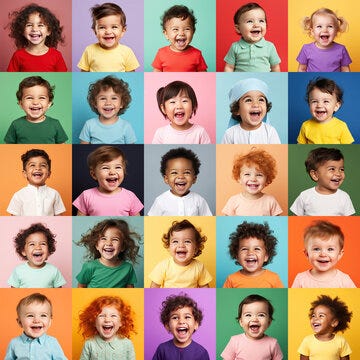
Whenever I have watched younger children interact and play together, I rarely see even a hint of bigotry or prejudice (unless, as is sometimes the case, they have already been greatly swayed this way in a home environment by their caretakers).
But in general, with very few exceptions, I see pretty much universal acceptance of each other “as equals” among young children (no matter their superficial differences in skin color, religion, sexual identity, ethnicity, or socio-economic status).
By the time we are adults, we have often learned to unlove, mistrust, and even h;ate those whom we perceive as being “different” than us. The origin of that fact is at least somewhat understandable. As alluded to earlier in this column, throughout human history (and our even longer prehistory) it has likely not always been in our best interest (if we wanted to survive) to love everyone as if they were our sister and our brother.
But we live in a different world now.
We now live in a world where our mutual global survival rests on our willingness to learn how to be more like little children. It may sound corny or unattainble to some, but we need to learn how to see all humanity as our brothers and sisters.
A little child I once taught in elementary school looked up at me one day and said, “Mr. Talley, I’ve heard grownups say that lovin’ everybody is hard. But it really ain’t that hard. What’s hard is when people don’t love each other.”